The Miami issue
Miami's Century-Old Trees and Where They Still Stand
A few hundred acres of the forest that stood here before the street grid are still alive across Miami, and most of it opens to visitors for eight dollars or nothing.
By Elliot MarshMiami by neighbourhood, on foot and in daylight

The oaks along Old Cutler Road close overhead in a tunnel that took most of a century to grow, and a few miles north, inside a hammock no wider than a city block, you can hear Brickell Avenue without seeing a single building on it. Miami sells shoreline and glass, and treats its trees as landscaping. But a scattered few hundred acres of the forest that stood here before the street grid is still alive, still rooted in the same limestone, and most of it opens to visitors for eight dollars or nothing at all.
A hammock is a dense hardwood forest growing on a slight rise of limestone: mahogany, gumbo limbo, live oak, strangler fig, a closed canopy, dim and humid inside even at midday. Pine rockland is the opposite, open sunlit slash pine standing directly on bare, jagged rock with a palmetto understorey, and it is one of the rarest forest types in North America, reduced to a few per cent of its original range. Almost everything worth seeing below is one, the other, or a deliberate attempt to rebuild them.
The three gardens that stocked the city

Fairchild Tropical Botanic Garden (Coral Gables) is where an honest Miami tree story has to start, because the palm and cycad collection assembled here is the reason so much of the exotic canopy in the surrounding streets exists at all. Walk the neighbourhoods south of the garden and you are effectively walking a distribution map of what was propagated behind these gates. Adult admission runs $24.95 to $32.95 depending on the day, children $11.95 to $18.95, and an online ticket for a weekday is the cheapest combination available. Gate prices are $5 higher, so buy before you arrive. Parking is free. Trams run all day, which matters if you are moving a large party or anyone who cannot manage two hours on grass; there is a dedicated Group Programs desk with pre-booked group rates, and it is worth using rather than turning up with fourteen people and hoping.

The Kampong (Coconut Grove) is where a great deal of that stock came from in the first place. This was the plant explorer's own home garden, the private ground where a great many of the tropical trees now shading Miami first landed, were nursed through their first seasons and then went out into the city. It is small, green, quiet and slightly ramshackle in the best way, and it feels much more like someone's life's work than a public attraction. Entry is $17 adult self-guided, $12 student or senior, $7 for children aged 6 to 17, with guided tours costing extra. Open Tuesday to Saturday, 9:00 to 16:30, last entry 15:00, and closed 3 to 6 April 2026. Parking is genuinely limited, so a reservation is strongly advised even for two people. Groups are accepted by advance reservation only and guided group tours are booked by phone; there is no walk-up option for a party.
Montgomery Botanical Center (Coral Gables) is the one most visitors never hear about. One of the finest palm and cycad collections on earth sits here, admission is free with donations encouraged, and hardly anyone visits, because you cannot simply arrive. Individuals and groups alike must arrange a prior appointment with the visits coordinator by email or phone. Treat that as a hard rule rather than a formality: this is a working research facility rather than a drop-in park, and staff time is what you are being granted. Expect real walking on uneven ground; it is not fully accessible. If you only have appetite for one appointment-based visit on your trip, make it this one.

Plan your Miami trip
Live prices from our booking partners.
Free cancellation on many rooms. We may earn a commission when you book.
What stood here before the street grid
Simpson Rockland Hammock Preserve Park (Brickell) is the single most important site in this piece, and you can walk through it in twenty minutes. It is the last surviving fragment of the Brickell Hammock, the forest that once ran along the coastal ridge, and it holds more than 160 plant species, fifteen of them endangered, with towers going up metres beyond the fence line. Entry is free. There are no facilities, no cafe and no interpretive centre, only trails, shade and a startling drop in noise. Note the name, too: it was officially renamed from plain Simpson Park, and the current name is what appears on maps and signage. The park is compact, so it is perfect for two people or a family and completely wrong for a coach party; small groups on the trails are fine, large ones simply do not fit.


Vizcaya Museum and Gardens (Coconut Grove) is famous for the formal Italianate garden, but the reason it belongs here is the rare rockland hammock behind it, left standing when the estate was carved out of the shoreline. Behind-the-scenes hammock tours run periodically and are worth watching the calendar for. General admission is around $25 adult, with hammock and garden tours adding $10 to $39 on top. It opens daily except Tuesdays, 09:30 to 16:30. Be realistic about the current state of the place: Main House guided tours are suspended for preservation work, and several garden features (the Maze, the Tea House, the Secret Garden) close intermittently, so do not build a whole afternoon around a specific one without checking first. Groups visit self-guided via the reservation form, with group rates by arrangement on 305-860-8442.

The Barnacle Historic State Park (Coconut Grove) is the best two dollars in Miami. Pedestrian and bicycle entry is $2, under-5s free, and that buys you the last intact piece of the old Miami Hammock plus the oldest house in Miami-Dade still standing on its original foundations, with a house tour available for a small extra charge at 10:00, 11:30, 13:00 and 14:30. The grounds open Thursday to Monday, 09:00 to 17:00, and close Tuesdays and Wednesdays. There is one quirk worth knowing: advance-reservation group tours run on Wednesdays and Thursdays, which means an organised party can get in on a day when the gates are otherwise shut to individuals. Book ahead and you have the hammock more or less to yourselves.
Deering Estate (Palmetto Bay) protects the largest surviving coastal pine rockland on Biscayne Bay, and it is the strongest preservation set piece on this list, a globally imperilled forest type kept alive on the edge of a metropolitan area that has built over nearly all the rest. Admission is $18 for adults 15 and over and $10 for children 4 to 14, and the guided nature preserve tour is included in that price, which is the crucial detail: the trails are guided-access only, and you cannot wander in on your own. Bird walks and night hikes run separately, and the night hikes are the memorable version if your dates line up. Open daily 10:00 to 17:00 with no entry after 16:00. Event spaces here handle anything from 60 people to well over a thousand, so this is the one estate on the list built for scale.

Old canopy in ordinary neighbourhoods

Pinecrest Gardens (Pinecrest) delivers the best value in this article: $8 for adults aged 2 to 64, $5 for over-65s, in exchange for a mature banyan and cypress canopy standing on the footprint of the 1936 Parrot Jungle. The banyans are the draw, with aerial roots down to the ground and whole rooms of shade under a single tree, and the paths are flat and pushchair-friendly. Open daily 09:00 to 17:00, though hours shift on festival days, which are frequent. School and community group bookings are routine and there is ample coach parking, so this is a straightforward choice for a large mixed-age party.

Enchanted Forest Elaine Gordon Park (North Miami) is the northern counterweight to all those southern gardens and the clearest proof of the secret-canopy argument: genuine mature oak hammock sitting in an entirely ordinary residential grid, free to enter, free to park. It opens at 07:00 and closes at 17:00, and that early hour makes it the best heat-beating walk on this list. Rental pavilions, picnic areas and regular public programmes mean groups are welcome without any arrangement.
Greynolds Park (North Miami Beach) was rebuilt rather than rescued. A worked-out quarry was reforested and has grown into intact hardwood hammock and mangrove, with a wading-bird rookery that is the real birding draw. Entry is free, with a small parking fee at weekends and on holidays; hours run roughly 08:30 to 16:30. Eco-tours of the rookery and boardwalk are run here, and the boat house rents canoes and kayaks, which makes it the most active-day option among the free parks.
Steinberg Nature Center at the Doc Thomas House (South Miami) is the Tropical Audubon Society's home ground, and you should come for the demonstration pine rockland rather than the architecture: interior tours of the historic house are currently suspended for restoration. The grounds and self-guided trails stay open and free, and this is the easiest place in the city to learn what pine rockland actually looks like at close range before you go and see it at scale elsewhere. Private event and seminar hire is available.

Miami Beach Botanical Garden (South Beach) is the only serious green canopy on the sand side of the bay, and it costs nothing. Tuesday to Sunday, 09:00 to 17:00, sitting between the Convention Center and Lincoln Road, it works best as a deliberate half-hour pause rather than a destination in itself. Free entry means groups can simply walk in, and workshops, classes and private event hire run alongside.

Shade at the waterline

Matheson Hammock Park (Coral Gables) is currently half shut. West Matheson, the hammock nature trail side across Old Cutler Road, has been closed since 17 February for an ADA boardwalk restoration due to finish in autumn 2026. If trees are why you are going, check the status before you set off, because the trail is the half that is shut. The east side stays open sunrise to sunset with the atoll pool, the beach, the marina and the restaurant, entry is free and parking runs roughly $5 to $7 per car. Picnic pavilions are rentable for groups.
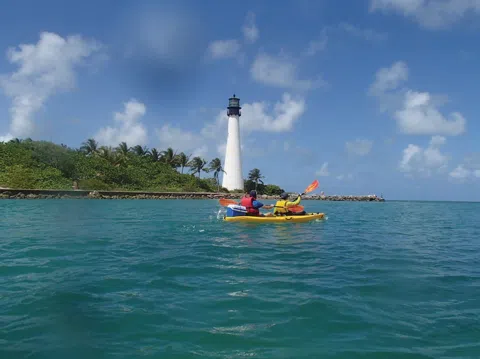
Bill Baggs Cape Florida State Park (Key Biscayne) is the most deliberate restoration of the lot. After Hurricane Andrew flattened the tip of the key in 1992, 350 acres of maritime hammock and mangrove were replanted using 1930s botanical records and aerial photographs as the reference, an unusually literal attempt to put back exactly what had been there. Thirty-plus years on, it reads as forest rather than planting scheme. Entry is $8 per vehicle carrying two to eight people, $4 for a single-occupant vehicle, $2 on foot or by bicycle. Two restaurants, bookable picnic pavilions and a lighthouse tour make it workable for organised parties.

Bear Cut Preserve (Key Biscayne, within Crandon Park) holds the view that sums up the whole subject: coastal hammock with an old-growth feel, a fossilised reef at the shoreline, and the concrete skyline standing directly behind it across the water. Trail access is free; Crandon parking costs somewhere around $7 to $10 per car. It is open sunrise to sunset. Pick up the trail map at the Marjory Stoneman Douglas Biscayne Nature Center, behind which the trails begin, and which runs school and group programmes if you are bringing children in numbers.
The canopy going in now
The Underline (running beneath the Metrorail from Brickell towards Dadeland) is where the city is putting the forest back rather than defending what survived. Phases 1 and 2 are open, from the Miami River to SW 19th Avenue, and Phase 3 down to Dadeland South completes during 2026, adding 1,800 trees and 350,000 native plants, replanted specifically as pine rockland and hardwood hammock communities rather than generic municipal greenery. It is free, entirely public and has no door policy at all, with guided walks, group fitness sessions and community programming running along the corridor. Walk a stretch of it after seeing Simpson and Deering and the intent is obvious: this is the city trying to stitch the two forest types back together along a line it already owns.

Who each place actually suits
For two people, or anyone travelling alone, the strongest half-days are The Kampong, Simpson Rockland Hammock Preserve Park, the Steinberg grounds and Bear Cut: quiet, unstructured, with no timetable to obey. For families, Pinecrest Gardens is the easy win on price and shade, Fairchild works because the tram removes the walking argument, and Greynolds gives children a boat as well as a forest.
For groups, the split is sharp. Fairchild, Deering Estate, Pinecrest Gardens and Vizcaya are set up for numbers and will quote you group rates. Montgomery Botanical Center, The Kampong and The Barnacle will take groups but only by prior arrangement, and turning up unannounced wastes everyone's morning. And three places on this list should not receive a coach at all: Simpson is too small, the Steinberg grounds are a nature centre rather than a venue, and Bear Cut's trails are narrow with parking shared across a busy park. Bring six, not sixty.
Planning it around the heat and the parking
A car makes this trip. The Old Cutler corridor (Fairchild, Matheson, Montgomery) and both Key Biscayne parks are awkward without one, and the northern pair, Enchanted Forest and Greynolds, sit well outside the rail network. The exception is the spine along US-1: Metrorail plus The Underline covers Brickell to the south comfortably on foot and by bike, and Simpson sits within walking distance of the northern end. Coconut Grove's own cluster of The Kampong, The Barnacle and Vizcaya is compact enough to combine in one day with short hops between them. Budget for parking on top of admission: $5 to $7 at Matheson, roughly $7 to $10 at Crandon, free at Fairchild and Enchanted Forest, and a small weekend charge at Greynolds.
Cards work everywhere, but carry a few small notes for state park entry booths and honesty boxes; The Barnacle's $2 and Bill Baggs's $8 per vehicle are quicker in cash. On timing, go early. Doors at Enchanted Forest open at 07:00 and most gardens at 09:00 or 09:30, and the difference between a 09:00 and a 13:00 hammock walk in summer is considerable, because heat, humidity and afternoon thunderstorms all stack up after midday. Mosquitoes are a genuine factor inside any hammock or mangrove trail regardless of season, so bring repellent rather than planning to buy it there; several of these sites have no shop at all. The dry months from November to April are the comfortable window, but the trees are evergreen and the canopy looks the same in August.
On money, a full week of this costs very little. Six of the sites here are free (Simpson, Montgomery by appointment, Enchanted Forest, Greynolds, the Steinberg grounds, Miami Beach Botanical Garden and The Underline), The Barnacle is $2, Pinecrest $8 and Bill Baggs $8 a carload. Only Fairchild, Vizcaya and Deering carry real admission, and each earns it. Base yourself in Coconut Grove or along the Brickell edge if you want to do most of this without long drives; compare rates with a Miami hotel search, and use the wider Miami guide to slot the trees around the rest of the trip. Check opening days before every single leg. Vizcaya closes Tuesdays, The Barnacle closes Tuesdays and Wednesdays, The Kampong is shut Sundays and Mondays and again from 3 to 6 April 2026, and West Matheson is closed outright until autumn.
Before you go
When is the best time of day and year to walk Miami's hammocks?
Go early. Enchanted Forest Elaine Gordon Park opens at 07:00 and most gardens at 09:00 or 09:30; by early afternoon in summer you are dealing with heat, humidity and thunderstorms. November to April is the comfortable window, but the canopy is evergreen and looks the same year-round. Bring insect repellent for any hammock or mangrove trail in any season.
Which of these places are free to visit?
Simpson Rockland Hammock Preserve Park, Enchanted Forest Elaine Gordon Park, Greynolds Park, the Steinberg Nature Center grounds, Miami Beach Botanical Garden and The Underline are all free, and Montgomery Botanical Center is free by appointment with donations encouraged. Matheson Hammock has free entry with a parking charge of roughly $5 to $7. The Barnacle is $2 on foot and Pinecrest Gardens is $8.
Can I visit Montgomery Botanical Center without booking?
No. It is a research facility rather than a public park, and both individuals and groups must arrange a prior appointment with the visits coordinator by email or phone. Expect real walking on uneven ground; the site is not fully accessible. Admission itself is free, with donations encouraged.
Is the nature trail at Matheson Hammock Park open in 2026?
Not yet. West Matheson, the hammock nature trail side across Old Cutler Road, has been closed since 17 February for an ADA boardwalk restoration due to finish in autumn 2026. The east side (atoll pool, beach, marina and restaurant) remains open sunrise to sunset, so check the status before travelling if the trail is your reason for going.
Do I need a car to see Miami's old-growth trees?
For most of them, yes. The Old Cutler corridor and both Key Biscayne parks are awkward without one, and Enchanted Forest and Greynolds sit outside the rail network. The exception is the US-1 spine: Metrorail plus The Underline covers Brickell southwards on foot or by bike, and Simpson is walkable from the northern end. The Coconut Grove cluster of The Kampong, The Barnacle and Vizcaya can be combined in a single day with short hops.